
Stock market volatility: What’s happening in 2026 and what could the future hold?
From record highs for the FTSE 100 to soaring oil prices, the first half of 2026 has been a rollercoaster for investors.
Such volatility and uncertainty can be unsettling, especially when the media forecast further stock market drops. However, as experienced investors will know, market fluctuations are an inherent characteristic of the stock market. Downswings are to be expected from time to time, and they’re generally not a cause for concern.
Understanding recent stock market trends and forecasts for near-term performance can often help reassure investors that volatility isn’t as worrisome as headlines might suggest.
So, read on to explore what’s happened in the stock markets in 2026 so far, what trends we could see throughout the rest of the year, and why staying calm through periods of volatility could help you benefit from long-term growth.
The FTSE 100 reached record highs early in 2026
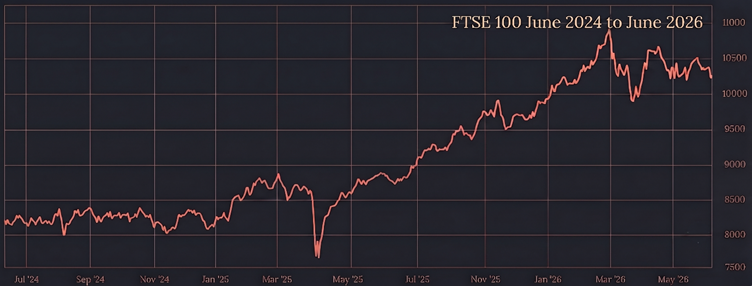
Between April 2025 and February 2026, the markets generally trended upwards, albeit with occasional dips and normal fluctuations along the way.
Source: London Stock Exchange (Note: past performance is not a reliable indicator of future performance).
Notably, the FTSE 100 – an index of 100 of the largest companies listed on the London Stock Exchange (LSE) – surpassed 10,000 points for the first time on 5 January 2026. Values continued rising until the end of February, peaking at 10,910 – an increase of around 9.64% since the start of the year.
Meanwhile, the FTSE All-Share index – a capitalisation-weighted index of 600 companies traded on the LSE – gained around 9.21% in the first two months of the year.
Share values dropped as war broke out in the Middle East
The outbreak of war in the Middle East sent a wave of uncertainty through the global markets. Generally, when investors’ confidence falls, so do share values.
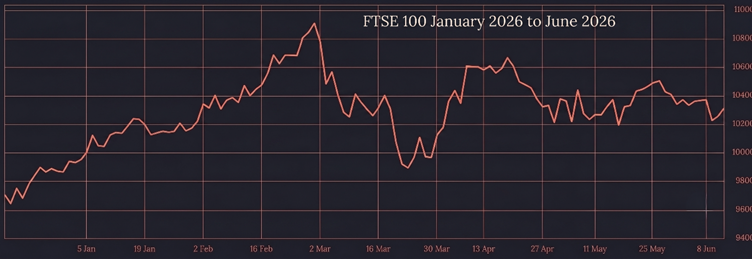
As such, between 27 February and 23 March, the FTSE 100 fell by around 9.32%. Meanwhile, the FTSE All-Share dropped by approximately 9.46%.
Source: London Stock Exchange (Note: past performance is not a reliable indicator of future performance).
Since the start of the conflict, share values have fluctuated as the geopolitical landscape has evolved. Oil prices have been particularly volatile, with the Strait of Hormuz’s closure causing significant supply chain disruption. According to the Guardian, the price of Brent crude oil jumped by 51% in March.
However, towards the end of May, the outlook started looking more positive, with the US and Iran reportedly approaching a deal that would see the Strait of Hormuz reopen.
As of 23 June 2026, the FTSE 100 was around 5.4% higher than its low in March, while the FTSE All-Share was approximately 5.69% higher.
The Bank of England has suggested the FTSE 100 will fall later in the year
In April 2026, BBC News reported on the Bank of England’s (BoE) prediction of a global market fall, citing potential macroeconomic shocks, waning confidence in private credit, and AI valuation adjustments as risk factors.
It’s often wise to take such “warnings” with a pinch of salt. No one knows for sure when the markets will fall or by how much. In fact, in the stock market, the only certainty is that values will fluctuate over time.
Even if the markets did take a downturn, it wouldn’t necessarily be cause for concern. As mentioned, volatility is part and parcel of the stock market. Crucially, values have historically recovered in the long run, as discussed below.
Historically, the markets have recovered from even their most significant downswings
While significant drops in share values can be unsettling, historical stock market trends suggest that such dips are often temporary.
Long-term investors have generally seen the markets recover from even their most significant drops. Not only that, but the markets have continued growing to exceed their previous highs.
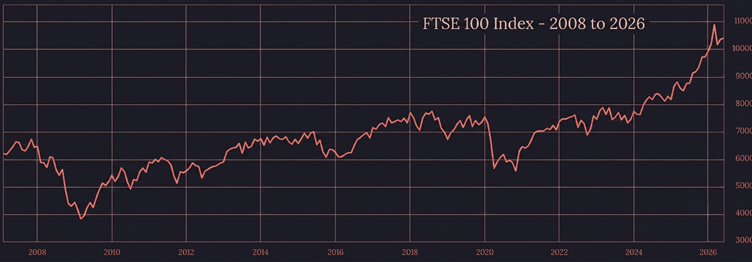
For example, the 2008 financial crisis saw the FTSE 100 drop by 43% between October 2007 and February 2009. However, values returned to their previous levels in 2013.
Source: London Stock Exchange (Note: past performance is not a reliable indicator of future performance).
Ultimately, those who “cut their losses” and sold their shares at the height of the crash in February 2009 will likely have locked in a loss. Meanwhile, investors who stayed the course through volatility may have seen their investments recover and continue growing to deliver positive returns.
So, provided you don’t plan to sell your shares in the short term, your investments could continue to grow beyond their previous highs.
That isn’t to say that selling in 2026 would mean accepting a loss. If you’re coming to the end of your long-term investment plan, the chances are you’ll still have made a positive return. For example, the FTSE 100 has risen by over 66% in the past 10 years. In fact, as of 23 June 2026, the index is higher than on 10 February 2026.
Step back and look at the bigger picture
If you’re feeling uneasy about the recent and ongoing market volatility, here are a few simple tips to help put your mind at ease:
- Shut out the media noise. If you’re keen to stay in the know, look for credible, balanced overviews targeted at investors, rather than following the headlines.
- Remind yourself of your long-term goals and investment strategy. This could help you realise you’re still on course to achieve your goals.
- Take a step back and consider the bigger picture. Close-up, downswings can look drastic. But if you zoom out and view them in the context of your long-term investment, you might realise they’re much less significant than they appear.
- Speak to your financial planner. If you’re still concerned, seeking professional advice from a trusted partner could help put your mind at ease.
As always, Chancellor’s financial planners are here to support you along your investment journey. If you’d like to discuss what 2026’s stock market trends could mean for your investment portfolio and long-term financial goals, get in touch.
Email info@chancellorfinancial.co.uk or call 01204 526 846 to speak to an adviser.
If you’re already a client here at Chancellor, contact your personal financial adviser to discuss any of the content you’ve read in this article.
Please note
This article is for general information only and does not constitute advice. The information is aimed at individuals only.
All information is correct at the time of writing and is subject to change in the future.
The value of your investments (and any income from them) can go down as well as up and you may not get back the full amount you invested. Past performance is not a reliable indicator of future performance.
Investments should be considered over the longer term and should fit in with your overall attitude to risk and financial circumstances.